Wednesday, 15 July 2015

The Frisian Islands


With a calmer sea and moderate wind we had a great sail across from Cuxhaven at the end of the Kiel Canal to Wangerooge, the most easterly of the Frisian Islands. There are 7 German Islands and 5 Dutch islands in the chain stretching about 100 miles along the north German and Dutch coasts, each island about 6 miles long.
The islands are really little more than sand bars that some grass and a few trees have managed to cling to! The islands were first popular long ago with monks looking to get away from it all as they do. Now each island has its own community and they have all become major beach holiday destinations.


Coming in to the channel towards the island from the North Sea we came across a colony of seals. There were a lot of young pups, some as small as a couple of feet long; cute and cuddly and considerably quicker over the ground than their somewhat blubbery parents when we got a bit close!


The centre of Wangerooge is a picturesque holiday resort with everyone getting about on bikes as there were no cars on the island. Cycling along the sea front we came across these rather super 'beach baskets', our wind break and deck chair all rolled into one. Mike and I had come across these before in Poland but these were off course much swisher!


From Wangerooge we headed west along the chain. The second island, Spiekeroog was well, another long sand dune, the third, Langeoog – yes, you get the drift. Getting from one island to another was however somewhat more entertaining. 

The islands are about 5 miles off the mainland coast with the water in between characterised by its lack of water – the whole lot dries out at low tide! This made for some interesting navigation. We set out from Wageorooge at about half tide so that we would hit the shallowest parts (yes literally) on a rising tide; that gave us about 3 hours of rising tide with a couple more hours of good water up our sleeve. The channels are continuously moving so charts are useless; they are marked by a series of withies, long willow saplings, driven into the sand at the edge of the channel and moved as required.
We set off into our first withie marked channel and very soon found the bottom.
Moondance has a lifting keel and with the keel up draws only 0.8 meters. I had hoped to find more water than that in the channel at this state of the tide! No matter, we dropped the anchor to wait for the tide to lift us off so we could continue which it duly did, happily just as another yacht passed us – on the other side of the withies! I had misunderstood the markings on the withies and headed down the wrong side – better luck next time. I was at least made to feel better by seeing the other yacht hit the bottom a few hundred yards ahead of us, but then he didn’t have a lifting keel!


Now that we had got to grips with the navigation we had a very pleasant evenings sail to Langeoog.


Tidal times and shallow depths became so tying that we did the rest of the trip along the islands on the North Sea side in plenty of water.
Chris had some friends staying on the German island of Juist that he wanted to meet up with so we anchored the boat off the beach and headed ashore in the dinghy where Chris’s friends stood waving, as did an official looking fellow with a red flag. As we hit the beach the official, who I think was beach patrol, came charging over communicating something to us loudly and forcibly in his best German. I invited him to try again in English as the only word I picked up was ‘verbotten’. He explained in his finest English this time (but no less forcibly) that dinghys were not allowed on the beach within 3 km’s of the village. What? How many dinghys do you suppose try and land on the wavey North Sea side of his island?! I told him that this sounded like a silly rule and suggested that he ignore it and let us see our friends that Chris had come all the way over from Australia to see. He looked at me as if I had 3 heads and explained again that this was a rule, dinghies on the beach were verboten. Germans it seems do not do flexibility! Poor Chris was spitting blood having made so much effort to meet up with his friends. Chris left Germany 30 years ago because he could not stand the German rules and rigidity – here was a very good reminder for him as to why he left and there were many less than polite expletives and gestures about Germany over the next day or two!


Unperturbed by Chris’s dislike of all things German this little fellow landed on the deck yesterday. Now, pigeons have a certain reputation, so I explained to it in no uncertain terms that if he left an unwanted present then he would end up in a pie for dinner. Unfortunatly the threat didn’t work; shortly after he had left Chris showed me his coat which was hung out to dry with a long runny white mess down the sleeve. This was of course hilarious, right up to the moment that Chris produced my water proof trousers carrying very similar markings!


Yesterday we left German waters. Chris took the opportunity whilst ashore shopping in the morning to relieve himself on German soil as a final gesture of defiance. With a few last departing gestures and expletives from Chris we crossed into the Dutch half of the islands. We decidd not to continue along the islands but rather to go into the short canal system which we decided would be a more interesting route down to the Zuider Zee and on to Amsterdam.

Thursday, 9 July 2015

The Kiel Canal

On 19 June Gordon and I arrived in Kiel at the Baltic end of the Kiel Canal where I wanted to leave the boat to come home for a couple of weeks. We were very lucky to find a berth;  it turned out to be the local race week and Kiel being the Baltic equivalent of our Cowes week was chocker block booked. Happily we did manage to find a berth 10 miles from the city center.
We had an interesting time getting in. It was blowing about 20 knots and I was allocated a berth a little way up an alley of posts. How they do it here is to park between two of a line of posts that run parallel to the pontoon, you then swing the boat between two of the posts and moor with the boats bows to the pontoon and secured at the stern on the posts. Unfortunately they neglected to tell me that the width between the two lines of posts was 15 meters – the length of my boat is 13.5 – a tad tight. It did look tight but doable – right up to the moment when I swung my bows in towards the posts and realised that the strength of the wind against the bow was simply not going to let the boat turn fast enough to get between the boats – I hit the brakes. I now had a problem. I had an umpteen point turn to do with a little under a meter of room at each end of the boat with 20 knots of wind making it quite clear who was in charge! To cut a  long and somewhat stressful story short I did manage to do my u turn and get out of the trot to retire to a much easier berth to access.  The boat was secure and it was time to sample Kiel.
The up side of the lack of parking in race week was that it was party time in Kiel. There were bands playing in every square and stalls selling every food and drink imaginable. This was an interesting smoked fish stand, cooked to order! 


And of course no party would be complete here without a German beer tent and a fellow dressed in his lederhosen and playing the accordion – knees up Mother Brown ( or some German equivalent!)

 After a lovely couple of weeks at home with Melanie I am back on the boat with Chris, an Australian friend. Chris is originally from  Germany but emigrated to Australia 30 odd years ago so with a crew who spoke the lingo perhaps my days of guessing what the milk was and what was in the sausages were over?!
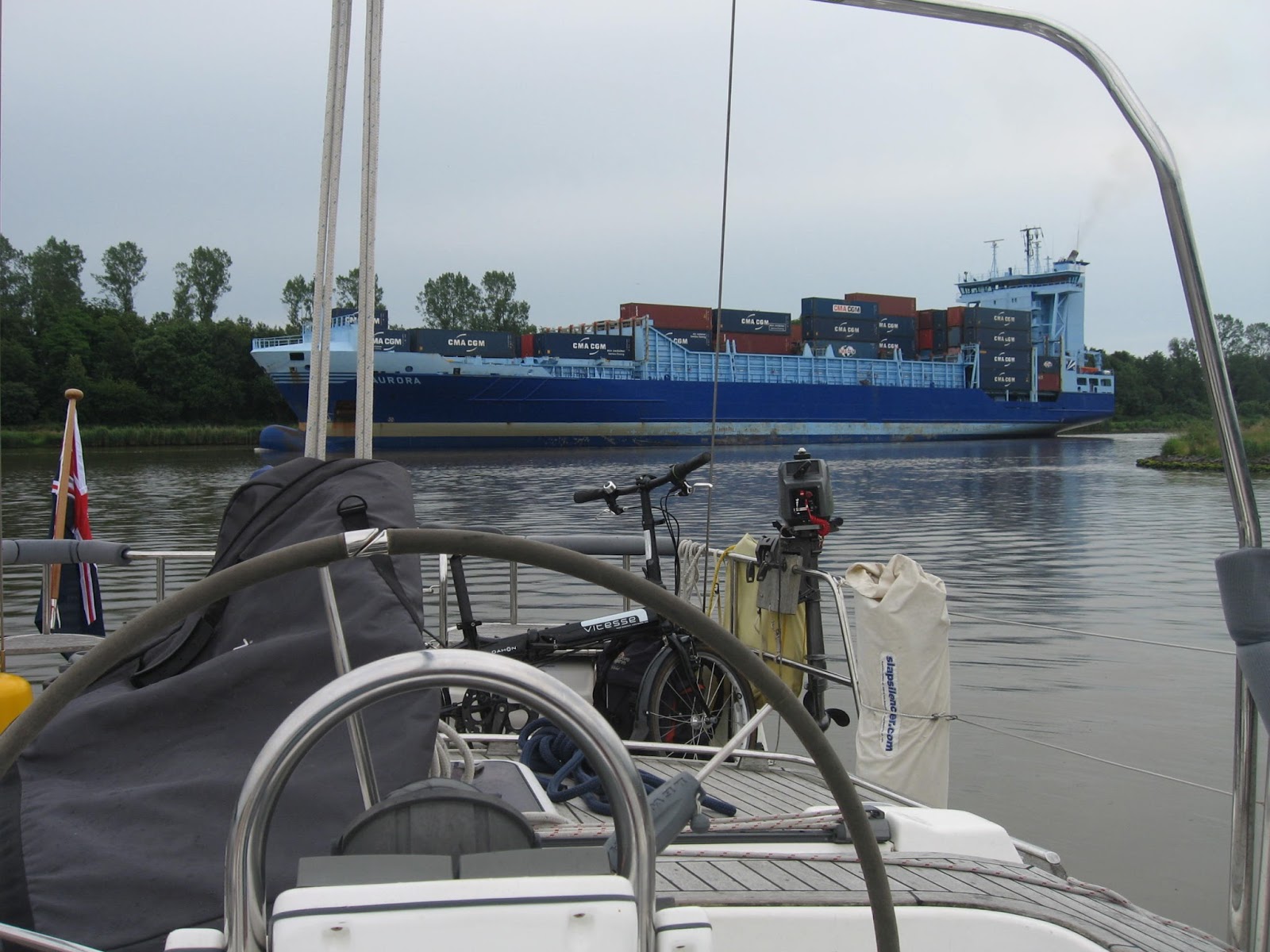
The first part of our trip was going to be through the Kiel Canal. The Canal, built in 1887, is a 50 mile short cut from the North Sea to the Baltic. It is a big canal having been widened to 100 meters just before the first world war to take Dreadnought battleships. There are locks at both ends of the canal to cope with the small tidal differences between the Baltic and the North Sea. Locks I had done before but these were something else – they were huge, but then the canal was built for some serious ocean going traffic! Moored alongside the wall with a container ship towering over us we were lifted the few feet  to the same level as the North Sea and we set off into the canal. 

We found a pretty lay bye for the night, one of those idyllic anchorage surrounded by mill pond calm water and trees – what I hadn’t counted on was the autobahn than ran over our heads just a few hundred yards away – so much for lonely peaceful anchorages!


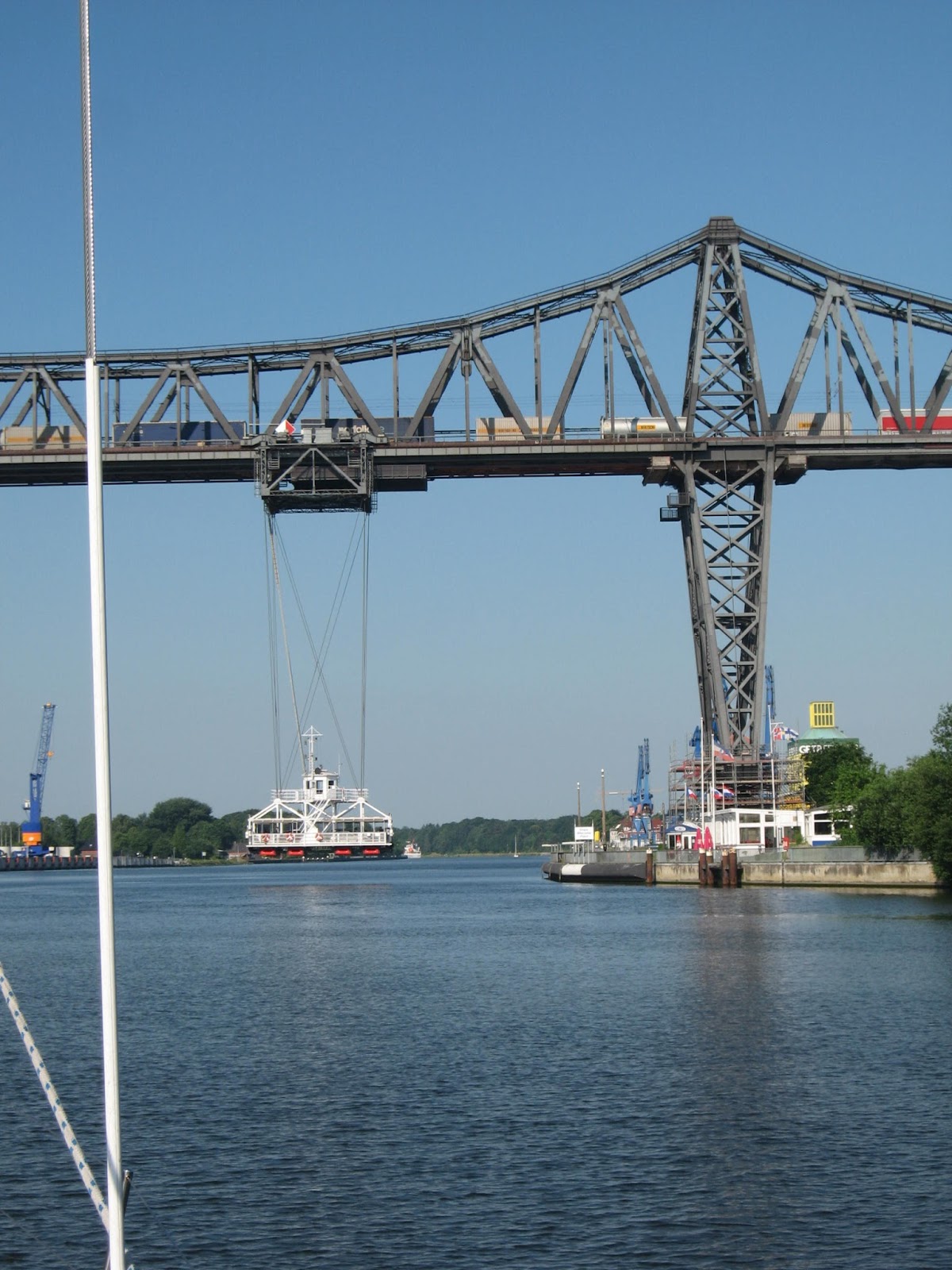
All along the canal were little ferries carrying people and cars. Here was an interesting piece of German ingenuity using a railway bridge to sling the 'ferry' underneath - neat!


We were against the wind so were motoring - it can be such hard work - Chris chilling at the wheel!


We motored 30 miles on our second day to another anchorage (carefully chosen to avoid the autobahn) then headed ashore on our bikes to explore a little bit of this part of Germany with its inhabitants living in some interesting places - a very regal looking pair of storks had found some prime real estate. 


We came across this wonderful windmill in a builders merchants yard that, although much altered inside, does still work today. The owner allowed the adventurous to clamber up inside the mill and have a look around. Judging by the layers of dust not many people had taken him up on his invitation! What a wonderful machine; huge wooden beams, a gigantic 8’ diameter wooden drive wheel attached to the rotor blades drive shaft and the mechanism to keep the whole shooting match turned into the wind – all still in some sort of working order. An engineers delight! This is the gear at the top of the windmill with the main shaft running through the centre.


The ceilings housed several families of young Swallows. Notice how the nest is  not sat on a ledge but ‘glued’ onto the end of a spar. The mother bird sticks little mud balls together with saliva to make the nest thus avoiding the ravages of  rats hunting in the eaves.


On the way home we met this young bride and groom in front of some farm buildings. I hope Hubby is happy with her, I found her a little prickly.


We are now sat storm bound in Cruxhaven at the mouth of the river Elbe having left the canal yesterday. There is a force 8 blowing outside and enormous cacophony of squeaking ropes and rattling rigging is serenading us! We spent the day exploring Bremerhaven, 20 miles up the Elbe by train. The boys in the RAF gave this whole area a real pasting at the start of the war as this is the only small stretch of German coast on the North Sea (and of course the locks of the canal took a pounding) so there is almost nothing left post war which makes the towns and cities rather characterless.

The wind is forecast to moderate tomorrow so we hope to head for the Frisian island - the land of Erskin Childers 'Riddle of the Sands'.

Wednesday, 17 June 2015

The Baltic can get a little too shallow!


Having scrapped through the bridge at the southern tip of the big island of Funen we anchored off the pretty town of Vordingborg, one of Denmarks oldest and historic towns with remnants of a medieval castle.


The next day we woke to a wonderful easterly wind, we would have it behind us, time to do some miles. We lifted the anchor and headed west. Heading for the next large island of Funen we stopped on route at the tiny island of Vejro, once populated by a small farming community it now caters only for and handful of tourist and a few passing yachts, very laid back and a lovely place to walk around.


 On the way back we came across this rather super fellow.


The easterly winds held for the second half of the trip to Funen and we bagged our first fish, a funny looking fellow that we identified as a Gar fish.


Not bad eating, very mackerel like but one extraordinary feature was that his bones were electric greeny blue! This is said to be as a result of the biliverdin in the fish, ‘ a green bile pigment also responsible for the greenish colour sometimes seen in bruises’ – well, there you go!


The winds gave up on us after a few hours and we motored the final miles into Svenborg on the southern tip of Funen.


A new town on a new island; time for another bike ride with a rather striking discovery. We were riding up a long hill out of town when we were flashed at by this sign. We were doing 14 kmph and the sign seemed to think that we were going at a snails pace - well we only had little bikes!
The photos a little out of focus but you get the gist. Damned cheek.


Our destination was  Egeskov castle which turned out to be a wonderful 16th century fairy tale castle that we decided must have been a gentlemans folly from the time. I liked it; if you are going to do, it do it properly, that is my kind of folly!


On the way home we passed this rather wonderful refurbished wind mill.


The following day we left Svenborg on a fine but blustery day heading for the small outer islands of Zeeland. Crossing something of an inland sea surrounded on all sides by islands none of which were higher than 100’ above sea level the water was shallow; the routes however are well marked by channel markers, the colour and shape of which tell you which side to pass to keep in the channel.

Even in June these waters are getting busy. After an hour or so we entered a particularly shallow and narrow channel. Coming the opposite way was one of many ferries running between the islands. Although in theory we had right of way over him because we were sailing I kept right to the edge of the channel to give him all the room I could, after all he was a lot bigger than me! He was quickly followed by another yacht to whome we gave way pushing us very close to the downwind side of the channel.
 If it got too shallow I  had a fallback plan in that I have a lifting kee. If it gets too tight, at the press of a button I can lift my keel and reduce my draft but I need it fully down to sail close to the wind properly. Whilst all this busyness was going on I was struggling to identify the next marker post. I could see it but I could not make out its colour and its shaped top was missing; I didn’t know which side to pass. Hedging my bets I decided to head straight for it for a last minute decision if which side to pass became clear or at least hugging it so close that I would get away with passing either side on the grounds that they wouldn’t cut the marking of the channel too fine.
 As I got close to the post it started to get really shallow. 3.2 metres, I draw 3.0 metres with the keel right down, it was time to lift the keel up a bit. I pressed the button – nothing. Oh dear. 3.1 metres. Press again – nothing - 3.0 metres. We were healing, that would make us draw a little less, 2.9 metres. Still no idea which side of the post to go. 2.8 metres. Bang, crunch, grind, oops, we had found the bottom of the Baltic and it didn’t sound like it was mud! Happily the keel can just kick up or it would be very dangerous hitting the bottom which would bring us to an instant stop. However, now we had a problem. 
Still nothing when I tried to lift the keel. The boat came to a stop pretty quickly. 2.7 metres now and  we were  being blown down wind and still further out of the channel. Let go of the sails, start the engine, grab the wheel and try and motor up wind. The bottom still had a firm hold. If we don’t sort this now I need to get the anchor out to stop us being blown into even shallower water, One more try on the keel lift button again, relief, it started to lift. Come on, come on, …. we were free. The engine powered us forward and we started to edge back towards the channel but the steering was desperately heavy, had I damaged the rudders somehow? The rudders draw less than a metre so they should be fine, why was the steering so heavy? Had we hit something with them? As the boat swung back into the channel I twigged, I still had the autotomatic steering  engaged, I was fighting the steering motor! Switch it off and all was fine. That was an eye opener, despite how familiar I was with my boat, with all the action that was going on I didn’t twig that the steering was being held by the auto helm. Oh well, you live and learn!  At that point I also realised that the reason for the keel not coming up was that sailing close to the wind puts tremendous sideways pressure on the keel and the lift motor was just not strong enough to overcome the sideways force. Another learning experience, I will remember that one in future. Sorry, no pics!
All's well that ends well and an hour later we were anchored in the shallows of the beautiful island of Aero.

Aero is a very picturesque island typifying the beauty and affluence of Denmark , apparently the wealthiest country in the EU measured as GNP per capita and it certainly shows. Everything is so tidy and perfect; even the poppies are special! Poppies dotted the fields everywhere adding to the picturesque atmosphere but this little fellow was rather different – like a four leafed clover, I don’t think you see many pink poppies! Definitely a good luck charm for the last week of the first half of the trip (but sadly it didn’t help with the weather in the days to come).

 Although the sun has lost its way the winds are now definitely in our favour. They have swung to the north-west giving us fair winds to continue south west and on to Germany. A brisk chilly wind whisked us across the last 20 miles of the Baltic at 7 knots on Tuesday to land us on the German coast at Kappeln, 15 miles north of Kiel, our final destination where we will leave the boat at the beginning of the Kiel canal whilst I go home for a couple of weeks.

Saturday, 13 June 2015

Zealand and and a bridge too low?

We left Copenhagen on a fine Sunday morning, 
sunny but still chilly and heading south. The Baltic is very shallow reaching depths of only 100’ many miles from shore and we are often sailing in only 10 or 20 feet of water. The consequence of this is that even a medium wind of 10 or 15 mph can push up a nasty sea, not high but steep which is very unpleasant to sail into. After a few hours of pleasant sailing we got just such a sea and after an hour of very unpleasant lurching and pitching we beetled towards the nearest piece of coastline to find sheltered water and motored the final couple of hours to our destination on the east coast of Zealand. From there it was a short hop to the island of Mon (no relation to that fine island off the north coast of Wales). Finally summer has arrived in Denmark and we were treated to a fabulous evening watching the swans around us.

It is quite hard to get your head around being surrounded by ducks and swans which of course would not be there if the water was salty; the Baltic is after all a big lake that is pretty much fresh water. 
One look at this lady got us thinking about a giant pan full of scrambled egg but she was having none of it.


Most of Denmark is very flat with the highest point being only a few hundred feet above sea level – wonderful biking! Mon is about 30 miles long so we took a bus out to the far end of the island and cycled back. We started at some rather spectacular cliffs. I have never seen the Dover cliffs this close up, I wonder if they are this white?!


Beautiful green rolling scenery passed us by, everything immaculately kept. Thatched cottages, flower decked gardens and some fine old churches going back many hundreds of years. 


When we are out on our bikes I always have a weather eye out for a few pretty wild flowers. I take them back to the boat and put my kindergarten training to good use making pressed flower cards to send to my long suffering wife so she knows that I haven’t forgotten her!


One of the hazards of travelling is the language. In much of Europe you can make out at least a little of the meaning of what’s written on the food packets as the languages all have the same Latin basis. Not in Denmark! The Scandinavian languages are quite different from any other European language and even a rough guess is quite impossible. The result? Just when you are really hungry after a long days bike ride and the gastric juices are flowing from the smell of some very fine looking sausages ... one lick and my mouth exploded – chillied – aaarghhhh - overboard they went!
Identifying the milk we want when we get to a  new country is always a problem. You would not believe how many different types of milk there are out there! In our early days in Denmark we ended up with soured milk on our cereal; who would buy soured milk?!


When we take the bikes ashore we put them in the dinghy and motor ashore powered by a small 2 horsepower outboard given to me a few years ago by a friend. It has been a superb little engine, totally reliable requiring only one pull to start it even after being put into hibernation for the winter. This year was no different; it started first time. However, after a hundred yards or so it started to cough and splutter finally deciding that taking us ashore was not a priority for the day. Another pull and off she went…. for about 10 seconds, same result. Again, 5 seconds. There was a problem; the symptoms were very much fuel starvation but fixing it would have to wait, we had a bike ride to do so out came the paddles.

Back at the boat I laid the engine on its side and started to strip it down to try and find the blockage. Having got the side off I realised that there was no fuel leaking out of the air breather on the top of the tank – there should have been because I forgot to close it before laying the engine down…..   How it got closed I do not know but our problem was not a blockage, it was the inability of the tank to breath as fuel was being used up because I had never opened the breather valve in the first place. I felt suitably stupid!


The islands are joined together by many bridges, something of a hazard for a yacht with a tall mast. The chart gives the clearance under the bridge so I always know if we can get under or not. However, what about when the clearance given is 20 metres and the top of my mast is 19.5 metres? In theory you either fit or you don’t. At 20 metres I should fit but in fact water levels can change even in an area of no tides because of changes in the atmospheric pressure. There are a lot of expensive toys at the top of the mast so I wasn’t taking any chances. The solution is simple. Drop anchor near the bridge. Find a crewman who has no idea what he is in for, put him in a nappy with a couple of harness rings on it whilst telling him what a wonderful view he will get and hoic him to the top of your 60’ mast. Once at the top of said mast, lift the anchor and motor nonchalantly on towards the bridge asking him to shout if he hits his head on the bridge. 


 It was looking pretty close...


Yes, that big grey thing above his head is the bridge, and that's me 60' below.


Happily for Gord, he didn’t hit his head so the mast was fine; he even enjoyed the view! 


Saturday, 6 June 2015

Wonderful, wonderful Copenhagen


We arrived in Copenhagen on Thursday after a lovely sail north amongst the offshore wind generators and past the long graceful bridge crossing the mouth of the Baltic Sea between Sweden and Denmark (beating into the wind of course!)


We found a berth in Christianshaven, a canal right in the heart of the city amongst the old warehouses and wooden sailing barges.


What a wonderful city is. There is a feeling of freedom and joy amongst the people. They all smile, have a spring in their step and manage to look elegant even when riding their bikes which pretty much take over the place! The roads are wide with cycle lanes everywhere. The Danes seem to have a very relaxed laissez fair attitude to life, very much in contrast to their Scandenavian cousins in Norway and Sweden where they most certainly would not cross the road if the red man was showing at the crossing. Here no one wears bike helmets, many smoke and they break what few rules there are with gay abandon!


Friday was a public holiday and party day, an annual holiday to celebrate the signing of the Danish constitution in 1849. We were out doing our tourist thing when we came across three youngsters attaching a bra to a rather fine looking statue. We asked them what they were up to and they explained that this year is the centenary of votes for women in Denmark. The sticking of bras to as many statues as possible before they got caught by the police was a protest that women still do not have equal right in Denmark! 


There was to be a rally which we stumbled across later that morning in part celebrating the centenary and part protest at female inequality. The march was huge. It was lead by very elegant young women dressed in suffragette clothing and flying Victorian style banners, they were still passing 15 minutes after they first passed us – a popular movement!


It is a beautiful city; many old buildings that survived the war (at least the last two, we Brits gave Copenhagen a real pounding in 1807 when we thought that they were getting a little too friendly with our old foe the Frenchies. Having pounded the city for 4 days we then ran off with the entire remains of the Danish fleet, 170 gunboats. Happily the Danes seeem to have forgotten that little incident!) Denmark was neutral in the first war, they tried again in the second but were soon occupied by the Germans but there was no damage done to their cities.


One of the most famous landmarks in Copenhagen is the little mermaid. Now here  is a magnificent piece of pr if ever I saw one! How does a small, rather insignificant statue given to the city by someone of no great importance and stuck on a rock on the water edge become the face of Copenhagen and the citys famouse monument? Who ever did that piece of pr I want to give them a job! 
The little statue was inspired by the mermaid who falls in love with a prince she rescues from a ship wreck  in the story by Hand Christian Anderson and was a gift to the city by the head of the Carlsberg brewery in 1913.


Copenhagen is known as little Amsterdam for its small canal system, the most famous of which is Nyhaven, home in years gone by to the whore houses and taverns serving the eclectic mix of seaman at this hub of sea trade routes around northern Europe. Today the old entertainment establishments are replaced with cafes and restaurants but old wooden sailing barges still line the canal, mostly now used a live aboards. 

On a sunny party weekend the cafes are full and the quay lined with buskers and a wonderful mix of people.


We came across one ambitious fellow building his own barge. Not only was he building it single handed from scratch but he even felled the trees himself! He has been at it 3 years so far with the hull complete and the decks under way, his hard wood planks lie on the dock along side him and he confidently tells me that he will have it sailing this summer – I love an optimist!


And then there is ‘The free state of Christiana’. If ever you needed proof of the laissez fair attitude of the Danes , this is it. In 1971 a group of squatters took over some deserted barracks in the eastern part of the city and established a commune. The local authorities initially tried to force the squatters to leave but, as the communities numbers swelled, the government decided to treat Christiania as a social experiment. Today the commune has 900 residents (it seemed either long grey haired hippies or younger Rastafarians and various coloured origins).


The commune has its own schools, infrastructure and system of government which are financed in part by cafes and the sale of handicrafts and yes, sale of the evil weed grown on the site! When I asked a lady selling Cannabis if it was legal in Denmark she explained that the police outside the commune regarded it as illegal but there was certainly no suggestion of illegality inside the commune. Sitting listening to the bands playing you could certainly get pretty high just from passive smoking from the many joints being smoked around you! As long as the commune are sensible about it the police seem to turn a blind eye. Upon leaving the commune there is a sign saying ‘you are now entering the EU’ – what a place!

Beautiful cities are always nice to see but what really makes travelling so special for me are the people you meet; the youngsters sticking bras on statues and the men building their canal barges from scratch – wonderful!

Mikes wife Sue and daughter Laura arrived in Copenhagen on Friday and joined us for a day of sightseeing. Gordon arrived on Saturday from Canada and joins me on the boat for the next leg of our journey.